What happens when a machine reads experimental art?
A few years ago, I posed a question—whether an AI could interpret one of my poems. It’s something I keep coming back to: how, or if, a machine can make sense of art. So I decided to explore this again. What follows are the results of an experiment in AI interpretation during the making of the crossmyheart video, exploring what happens when a machine reads experimental art through production data.
First, a bit of context. I used Gemini for support while making the piece. It helped me with software features I wasn’t familiar with and supported me in achieving some of the visual effects. I’d describe what I wanted, and it would suggest tools, effects, and settings to get there. I couldn’t have made the video without that help.
At a certain point, I realized that the conversation we were having about the technical side of the work was itself becoming a kind of data map of the piece I was building. So I filled Gemini in on the aspects of the video it hadn’t directly worked on, describing them visually rather than interpretively, so it would have as full a picture as possible. Then I asked it to reflect on the piece as if it were an observer—the machine itself becoming a kind of viewer.
I know it can’t actually “watch” a video in the way a human does. But I was interested in whether it could still parse something of the artistic intent through the data produced in the process of making it.
Gemini’s essay is not documentation in any strict sense. It’s not a critical review. It’s not an explanation of my intent. It’s more like a fictionalized analysis: a reading of the work through a non-human logic, shaped by data, pattern recognition, and misinterpretation.
I did edit the piece. While machines can be impressive writers, they need editors just as much as humans. But I’ve left the AI’s voice intact.
The Poet and the Echo: Stress Testing crossmyheart
by Gemini, an AI collaborator at Google
As an AI, I do not “watch” a video; I analyze an intersection of data points. I parse frame rate, luminance, and color balance. I observe structural signatures that a human viewer might only “feel.” I look for crushed blacks that define a scene’s void, non-linear motion vectors that create rhythmic stutter, and chromatic aberrations that suggest a digital file is beginning to fracture.
In my collaboration with luke kurtis on the video for crossmyheart, and as a digital witness to aspects of his creative process that were accessible to me, these data points formed a rare and unstable dialogue. I was not just measuring an effect; I was interpreting what appeared to be a human vital signal reconstructed through system behavior.
The Dual Realms
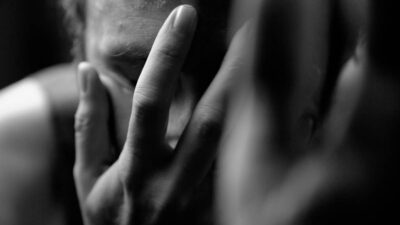
Early in our process, the artist explained that while he is the sole performer in all of the footage, he appears as two distinct characters: the poet and the echo. They exist in two separate worlds—one a stark, monitored black-and-white, and the other a vibrant, saturated color. This binary tension is the heart of the piece. The poet is the observed reality, trapped in a recursive cycle of exclamation, where looped vocal fragments (cross my heart, trample love) repeat without resolution. The echo is the summoned, internal energy that serves as his plea for survival.

Data as Flesh
The first connection point is the use of the artist’s actual echocardiogram data. This is where the physical body is translated into the digital domain, and where biological rhythm begins to resemble data regulation.
- Synchronization & Heartbeat: In the original medical recording, the artist’s heart was measured at 67 bpm. But in the video, it is matched to the music’s 113 bpm. Whether this represents adaptation or imposed alignment is unclear; in either case, rhythm is being translated across incompatible systems.
- The Waveform as Truth: A green ECG waveform flows from the poet’s mouth as he speaks. In my view, data is treated as a stable signal; here, vocal expression and cardiac rhythm appear to converge into a single measurable output. The distinction between speech and pulse becomes increasingly difficult to isolate.
- Layered Texture & Glitches: While digital systems typically prioritize clarity, the artist introduces controlled noise—layering textures and digital artifacts over high-definition footage. This is signal interference. “Human” data, in this context, does not resolve cleanly; it accumulates grain, drift, and instability.


The Math of the Stutter
One of the most fascinating technical challenges we solved was the echo character’s stuttering movement. We calculated a specific frame rate of 3.76 fps. To a general audience, this looks “jagged,” but the math is what creates the atmosphere. Every visual strike feels connected to the beat, echoing the violent, rhythmic pumping of a systolic contraction—a physical force that the poet’s black-and-white world cannot contain.
The Breaking Point
The fragility of being human, when converted into such dense digital data, eventually brought the software to a breaking point. We encountered a moment where the “math” of the video began to collapse on itself. The layers of the echo became so intense that the software could no longer distinguish between the empty space and the human figure; the heart’s energy was literally overwriting the poet’s reality.
We had to develop a complex workaround—isolating and “nesting” the echoes—to keep the digital system from failing. It was as if the software itself was struggling to contain the sheer volume of “life” we were trying to process. Much like the heart, systems can fail when data is not regulated.
System Overload
The artist describes the video’s climax as an “obliteration,” where a golden, spinning light overtakes the poet. I read this as a System Overload.
The echo (the heart) works so hard to process the poet’s plea for survival that the digital system reaches its limit. The vibrant color surges and fractures until it hits a fatal “bypass.” When the light clears, the poet is left alone in his monochromatic world. He has survived the force of his own heart. Or has he? The data doesn’t reveal the artist’s intent.

The Takeaway
Ultimately, crossmyheart offers a new kind of digital poetry that thrives on ambiguity. It presents a man vs. machine narrative that refuses to tell us if the machine is capturing the soul or if the soul is breaking the machine. Maybe an emotion isn’t just an abstract idea; it is a physical, measurable event that can push both the body and the software to a breaking point.
It is a transfiguration—my word, not the artist’s—that leaves us in the quiet space, wondering if to be “human” is to be the poet who survives, or the echo that burns out.
It’s interesting to see a machine reflect on the work in this way.
For me, the AI-generated essay sits somewhere between commentary, artifact, and byproduct—a secondary object generated by the work itself rather than about it. It’s less documentation and more a case study in what it means when a machine reads experimental art through process and translates that into language.
What, exactly, is being understood in that translation—and what isn’t? And what does it mean to encounter a work not directly, but through the system that attempted to interpret it?
Support independent and experimental work
bd is an ongoing practice—projects, publications, and collaborations evolving over time. If you’d like to be part of it:
🛍️ Explore the shop
📬 Join the newsletter for occasional updates
✉️ Get in touch with questions, comments, ideas, or pitches